
RFK Stadium

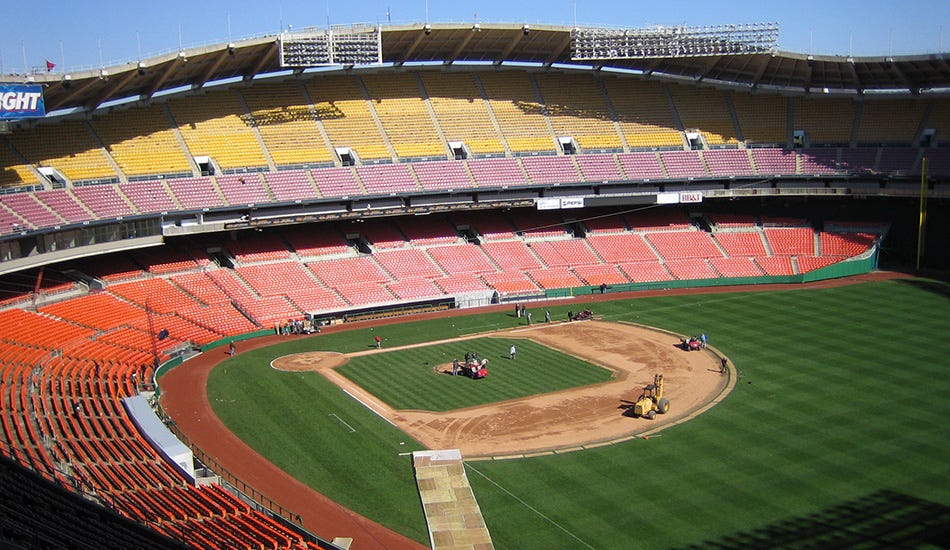
Robert F. Kennedy Memorial Stadium, commonly known as RFK Stadium, holds a unique place in American sports history. Opened in 1961 as D.C. Stadium, it was among the first multipurpose stadiums designed to host baseball and football games. Its construction, funded by the federal government, cost $24 million and showcased innovation in stadium architecture. Renamed in 1969 to honor the late Senator Robert F. Kennedy, the stadium became a cultural landmark in Washington, D.C., hosting not only professional sports but also concerts, political rallies, and significant events like Mass by Pope John Paul II in 1979.
The stadium was home to several iconic teams over the decades. The Washington Senators, a Major League Baseball team, played there from 1962 until their relocation in 1971. Decades later, RFK hosted the Washington Nationals for their first few seasons, from 2005 to 2007. The Washington Redskins (now the Washington Commanders) played their home games there from 1961 to 1996, during which the team won multiple championships. RFK also hosted D.C. United, one of Major League Soccer’s founding teams, from 1996 to 2017. The stadium’s versatility allowed it to host all sorts of events, cementing its reputation as a multipurpose venue that could bring together fans of different sports and entertainment.
Architecturally, RFK Stadium was an innovative design for its time. The elliptical bowl shape, created by architect George Dahl and structural engineers Ammann & Whitney, featured movable seating sections that could be reconfigured to suit football and baseball games. This mechanized seating system was revolutionary. It allowed the stadium to transition seamlessly between sports. Its compact and intimate design brought fans closer to the action, creating an electric atmosphere. Despite its modern exterior being simple and utilitarian, the stadium’s functional design influenced the construction of other multi-purpose venues in the 1960s and 1970s.
While RFK Stadium’s design was ahead of its time, it eventually became outdated. By the late 1990s, specialized, single-sport stadiums like FedEx Field and Nationals Park replaced it as the preferred venues for professional teams, after hosting its last event, a D.C. United soccer match in 2017, the stadium was closed and is now slated for demolition. Despite its decline, RFK remains a beloved symbol of Washington, D.C.’s sports and cultural history. Its legacy lives on as a testament to the passion of fans and the innovative spirit of mid-20th century architecture.